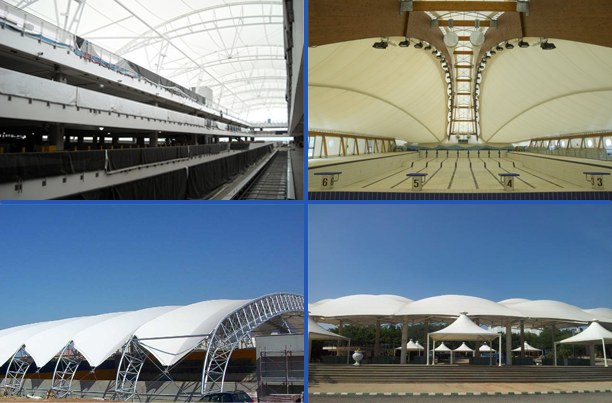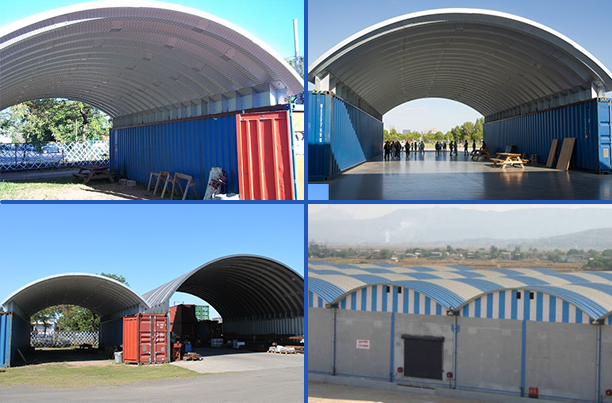











Petcoke Storage, Stockpile, Sheds & Domes

TURNKEY SOLUTION FOR PETCOKE STORAGE & DOME

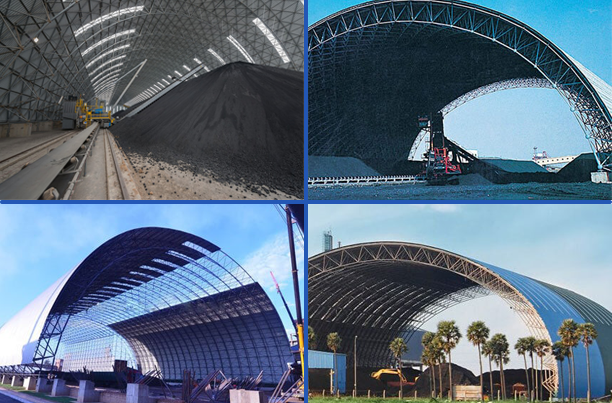
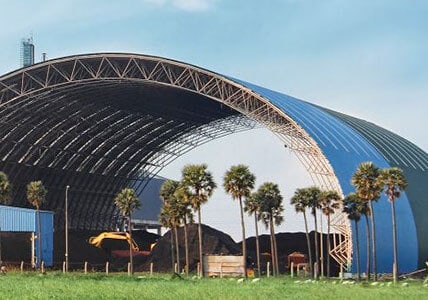
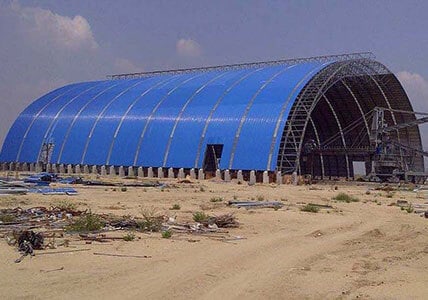
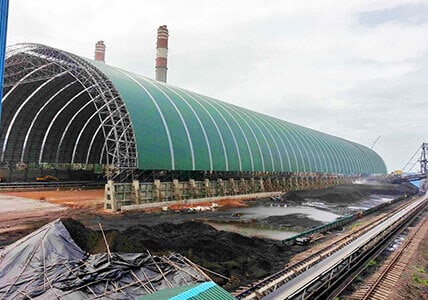
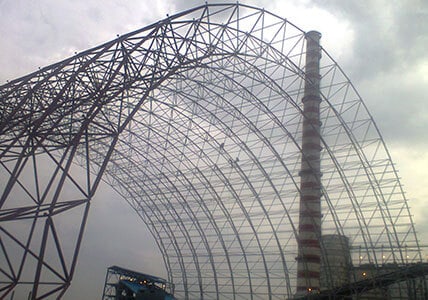
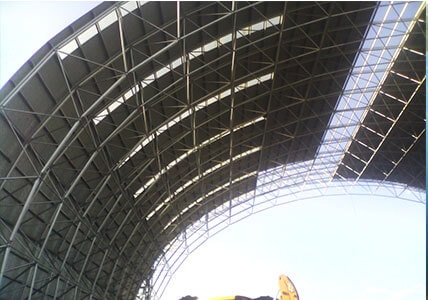
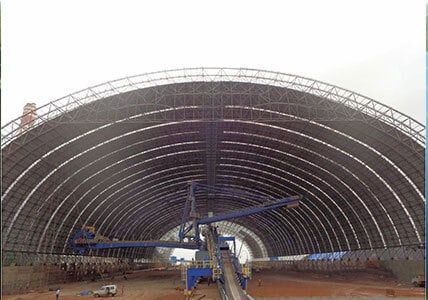
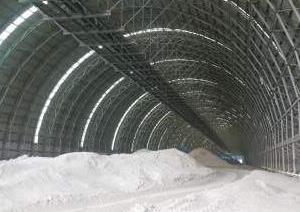
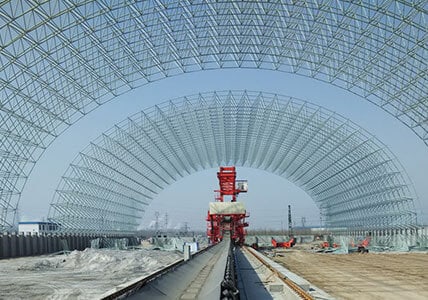
We are specializes in the storage solutions for petcoke with the long span of steel structure, having a span of up to 150m and height of up to 40m. Petcoke storage shed, engineered by Hindustan Alcox, is the perfect solutions to cover stockpile for the most challenging environment. Petcoke storage sheds and domes are often built over operating stockpiles so that the construction may be proceed without interrupting the operations. Because of our erection process does not require machines to be installed in the periphery of the span. Petcoke storage system is a very dynamic system, where many compounds and inappropriate conditions interact to form intervening compounds that can cause safety concerns.

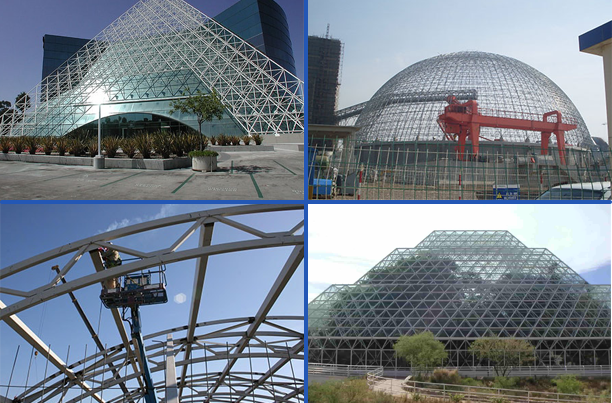
Petcoke Domes

In addition to barrel vault structure, Petcoke Dome is also an appropriate choice for the storing and covers a large span to facilitate the storage under the same shed. We customizes petcoke dome after practically emphasizing the durability, strength and technical feasibility of structure with optimum space utilization. We are leading petcoke storage, dome, stockpile and shed manufacturer, installation and all solutions from last 50 years in India and worldwide including Asia, Africa, UK & USA with assurance of quality.

OTHER APPLICATIONS OF OUR STRUCTURES

LIMESTONE STORAGE

The cement manufacturing process starts from the mining of raw materials that are used in cement manufacturing, mainly limestone and clay.
The limestone is excavated from open cast mines after drilling and blasting and then loaded onto dumpers, which transport the materials and unload it into hoppers of limestone crushers. The clays are excavated from open cast mines and loaded onto dumpers, which transport the materials and unload it into open yard storage.
As we know cement manufacturer or cement company operator have to ensure that their product maintain quality and consistent properties. But most of the limestone quarries produce material of varying chemical composition. To obtain consistent quality in final product, quarried raw material must be blended before it is fed into the kiln. With our structure, any amount of limestone can be stored
Although stockpiles are created by slewing stacker to minimize fugitive dust, most of the cement producers enclose their stockpile to protect the surrounding environment, and to prevent loss of material due to water runoff and wind.
Limestone storage sheds are the best choice to cover stockpile. It is a low cost solution because fabrication and erection of the structure takes less time. We provide solution for Bulk storage –

  • In-house design, fabrication and erection of Limestone shed.
  • Designing and pre-fabrication of component by using computers.
  • Packaged and shipped in small units that can be by hand unloaded in remote locations.
  • Assembled over a stock pile or stockyard while the stockyard remains in operation.

The construction systems uses mild steel in case of limestone shed, no welding is required because the connection of the member consists of a very efficient moment-resistant mechanical joint. Limestone shed may be built in single- or double-layer configurations, depending on the load and span for the application. Experience suggests that for the spans required in limestone covers, a-double-layer is the most cost-effective
Limestone storage shed are often built over operating stockpiles since construction can proceed without interrupting operations.

Clinker consists of various calcium silicates including alite and belite. Tricalcium aluminate and calcium aluminoferrite are other common components. These components are often generated in situ by heating various clays and limestone.
Clinker consists essentially of four minerals:

  • Alite: approximately tricalcium silicate (typically about 65% of the total)
  • Belite: approximately dicalcium silicate (typically about 15% of the total)
  • Tricalcium Aluminate: Typically about 7% of the total
  • Tetracalcium Aluminoferrite: Typically about 8% of the total

Cement is caustic, so it can cause chemical burns. The powder can cause irritation or, with severe exposure, lung cancer and can contain some hazardous components such as crystalline silica and hexavalent chromium . Environmental concerns are the high energy consumption required to mine, manufacture, and transport the cement and the related air pollution, including the release of greenhouse gases (e.g., carbon dioxide), dioxin, NOx , SO2 , and particulates. Therefore, it is essential that clinker should be properly stored in covered sheds.
The construction systems uses mild steel in case of clinker storage, no welding is required because the connection of the member consists of a very efficient moment-resistant mechanical joint. Clinker storage shed may be built in single- or double-layer configurations, depending on the load and span. Experience suggests large spans are required in clinker storage , a-double-layer is the most cost-effective Clinker storage sheds are often built over operating stockpiles since construction can proceed without interrupting operations. Because our erection process does not require machines to be installed internal periphery of the span.

A soft white or gray mineral consisting of hydrated calcium sulfate. It occurs chiefly in sedimentary deposits and is used to make plaster of Paris and fertilizers, and in the building industry. Gypsum, a white mineral soft enough to be scratched with a fingernail, is hydrated calcium sulfate [Ca(SO4) 2H2O]. Gypsum often begins as calcium sulfate dissolved in an isolated body of salt water. As the water evaporates, the calcium sulfate becomes so concentrated that it can no longer remain in solution and crystallizes out (precipitates) as gypsum. Many large beds of gypsum have been formed in this way.
Gypsum occurs in a number of distinct forms, including a clear, parallelogram-shaped crystal (selenite); a white, amorphous form (alabaster, used for ornamental carving); and a fibrous, lustrous form (satin spar, used in jewelry). When ground up and heated to drive off its water, gypsum becomes a powder termed plaster of Paris. Plaster of Paris has the useful property of hardening in any desired shape when mixed with water, molded, and allowed to dry. Gypsum is one of the most widely used minerals in the world. Some 90 countries mine gypsum, producing more than 100 million tons (91 million metric tons) annually. The construction industry has long been particularly gypsum intensive. In the late nineteenth and early twentieth century’s gypsum was widely used in plastering, which since the 1950s has been displaced by gypsum drywall (sheetrock). Gypsum is also an ingredient in Portland cement, which used in the construction of bridges, buildings, highways and millions of tons of gypsum used annually as fertilizer. Small quantities of pure gypsum are essential in smelting, glassmaking, and other industries.
We want to make Gypsum storage easy for you; we proved long span steel structure for your gypsum pile
We would like to propose Large Span Steel Shed, which can be used to cover gypsum; it can built with a span of up to 150 m and height of up to 40 m.
Gypsum storage sheds are often built over operating stockpiles since construction can proceed without interrupting operations. Because our erection process does not require machines to be installed internal periphery of the span.

Iron ores are rocks and minerals from which metallic iron can be economically extracted. The ores are usually rich in iron oxides and vary in color from dark grey, bright yellow, deep purple, to rusty red. The iron itself is usually found in the form of hematite (Fe2O3), magnetite (Fe3O4) goethite (FeO(OH)), limonite (FeO(OH).n(H2O)) or siderite (FeCO3). Ores carrying very high quantities of hematite or magnetite (greater than ~60% iron) are known as “natural ore” or “direct shipping ore”, meaning they can be fed directly into iron-making blast furnaces. Iron ore is the raw material used to make pig iron, which is one of the main raw materials to make steel.
Our Iron Ore Storage Structure is fully Complying with new environmental regulations for air quality, Prevention and control of fugitive emission. Instead of investing in temporary solution, it is recommended to adopt permanent solution. Our solutions presented here not only allow affordable compliance, but also enhance the reputation of your plant. In addition, one time investment is much more economical than the periodic investments

Lignite-generated electricity is abundant, low-cost, reliable and environmentally compatible.”
Lignite is a dark brown to black combustible mineral formed over millions of years by the partial decomposition of plant material subject to increased pressure and temperature in an airless atmosphere. In simple terms, lignite, often referred to as brown coal, is a soft brown combustible sedimentary rock formed from naturally compressed peat. It is considered the lowest rank of coal due to its relatively low heat content. It has a carbon content around 25-35%.
Lignite is brownish-black in color and has a carbon content around 25-35%, a high inherent moisture content sometimes as high as 66%, and an ash content ranging from 6% to 19% compared with 6% to 12% for bituminous coal We would like to propose Large Span Steel Shed, which can be used to cover lignite; it can built with a span of up to 150 m and height of up to 40 m.The construction systems uses mild steel in case of lignite storage, no welding is required because the connection of the member consists of a very efficient moment-resistant mechanical joint. Lignite storage shed may be built in single- or double-layer configurations, depending on the load and span. Experience suggests large spans are required in lignite storage , a-double-layer is the most cost-effective. Lignite storage sheds are often built over operating stockpiles since construction can proceed without interrupting operations. Because our erection process does not require machines to be installed internal periphery of the span.

Additives are chemicals and materials blended into base cement slurries to alter the performance of the cement. Due to the inherent nature of base cements (Neat, Portland and Pozzolanic) and because of the demands placed on the cement cover throughout the life of the structure, the performance properties of the cementing slurry are modified to address the specific and unique conditions of each structure.
Additives are used to enhance cement slurries in all wellbore conditions. Variations in additive concentration may cause significant changes in thickening time, compressive strength, and viscosity, so determining the optimum balance of additives to achieve a reliable annular seal, particularly in extreme or corrosive down hole conditions, can be complex. Thus, field-proven technical solutions, laboratory-driven empirical data from analytical tests, and finite element analysis models play an important role when engineering an optimized slurry blend Additive storage sheds are often built over operating stockpiles since construction can proceed without interrupting operations. Because our erection process does not require machines to be installed internal periphery of the span.

Product Gallery

enclosed coal storage shed facility
industrial coal storage shed structure
large-span coal stockpile shed
dust-controlled coal storage enclosure
steel coal handling shed for power plant
weatherproof coal storage shed system
bulk coal storage covered shed
coal storage shed facility

PRODUCTS & SERVICES

Contact us

Get in touch for a quote or simply to discuss how we can contribute to your project

Partner with Us:

Telephone: +91-11-6537-6653 / 54
Mobile: +91-99586-46644 | +91-98183-02640
For International Projects: +91-99999-22307
Fax: +91-11-23588087
Email: info@alcox.in

Our Values:
Contact Us